
EXECUTIVE JOB SEARCH ADVISORY
The Senior-Level Job Market Is Bigger Than What You Can See
At the senior level, some of the best job opportunities are never posted.
They may begin as an emerging need, a confidential discussion, a role still being shaped, or a conversation inside a company long before anyone decides to advertise it.
That means a traditional search can leave you competing only for the part of the market everyone else can already see.
A proactive executive job search works differently. It starts with your career goals, then reaches into the less-visible part of the market by identifying the organizations and decision-makers most likely to have a reason to talk with you.
A private, exploratory conversation. No obligation.
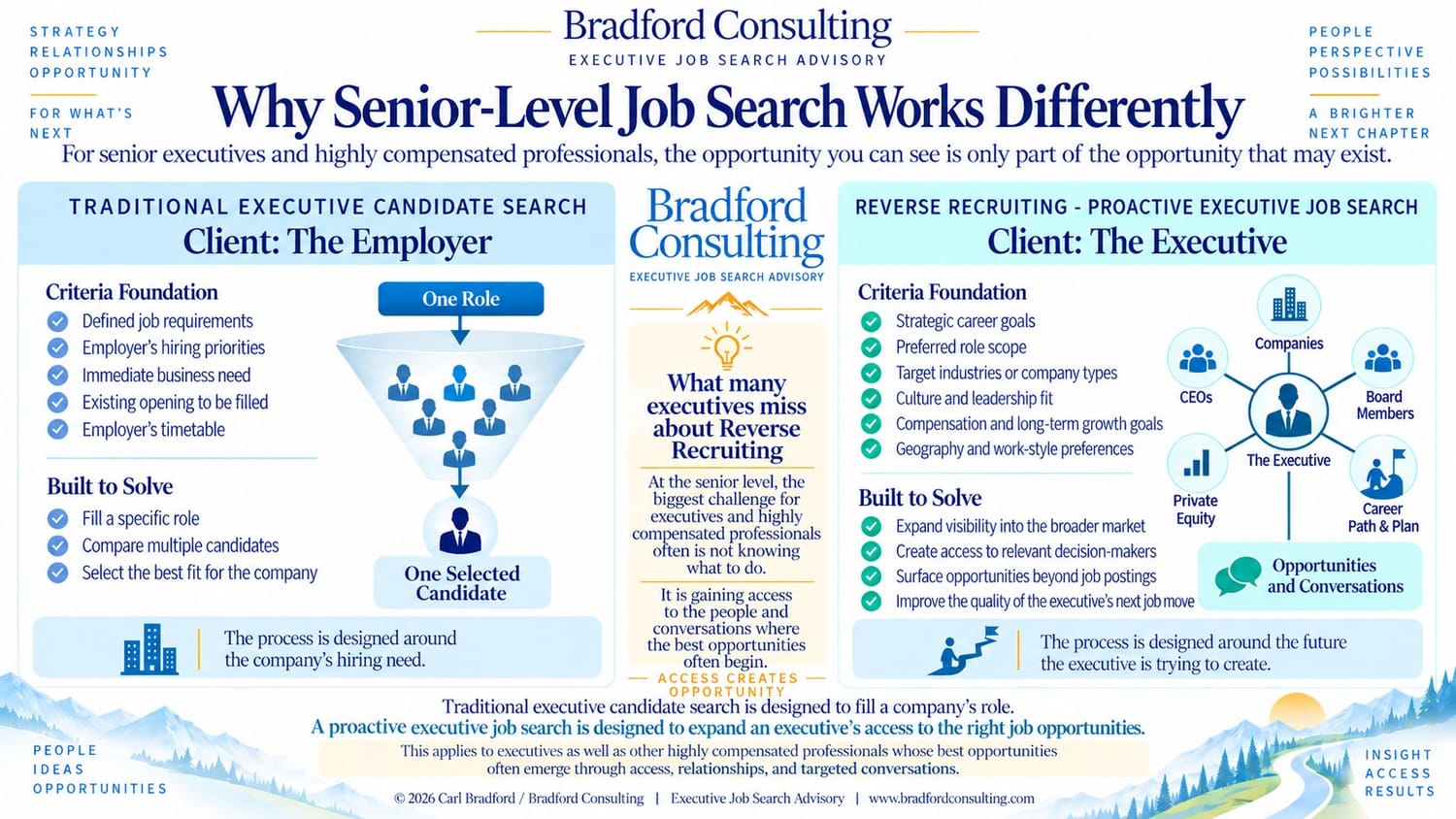
Reaching the less-visible market requires a different model.
Reverse recruiting turns traditional executive search around - starting with one executive and working outward across many organizations and decision-makers.
Tap Image to Enlarge
What Senior Executives and Highly Compensated Professionals Say They Value
What stands out most in the feedback from senior executives and other highly compensated professionals is not simply that they found opportunities they had not seen before.
It is how much broader their search became once they gained access to people, companies and conversations beyond the reach of job postings and their existing network.
Reach organizations, executives, board members and private-equity contacts beyond your existing network.
Create targeted discussions with people who can influence, shape or open the door to the right opportunities.
Develop multiple targeted conversations in parallel instead of relying on one contact, recruiter or application at a time.
Surface roles, leadership needs and opportunities that may never appear in a public job posting.
Build relationships that create future opportunities, warm introductions and lasting career value.
The real advantage is not simply finding “hidden jobs.”
It is expanding the market you can actually reach.
The Bigger Question Is How to Reach More of the Market
Knowing there are opportunities beyond job postings is one thing.
Systematically reaching the right companies and decision-makers - at meaningful scale, while keeping your search private - is something else.
A senior executive or highly compensated professional can certainly network independently. The limitation is usually not ability. It is reach, time and scale.
A proactive executive job search begins by defining what the right next move looks like for you. From there, the market can be mapped around your criteria - role, company type, industry, geography, compensation, culture and long-term career direction.
Then the focus shifts from waiting for openings to creating targeted conversations with the people who can influence hiring decisions, identify emerging needs, make introductions or recognize a fit before a formal search ever begins.
PRIVATE SEARCH. MEANINGFUL SCALE.
This is not mass resume distribution.
The objective is personalized outreach to a much larger, carefully selected market while keeping your search private. You remain effectively anonymous to the broader market, with your identity shared selectively only when a relevant conversation makes sense.
Your Competiton Changes Too
When you apply to a posted senior-level role, you may be one of many qualified people trying to get noticed..
But when the right conversation is created before or outside a formal posting, the competitive picture can be very different.
You may be one of a small, select group being considered.
And sometimes, you may be the only one.
The earlier you enter the conversation, the less likely you are to look like just another applicant.
There’s a Specialized Way to Do This
I don’t provide reverse recruiting services directly.
My role is to advise senior executives and highly compensated professionals on important career decisions - and, when a situation calls for specialized expertise, connect them with people whose work and approach I know and trust.
For proactive executive job search, I may introduce qualified individuals to an independent specialist whose work is focused on building a search around the individual rather than around one open job.
The process starts with your background, your value, your target role, company preferences, compensation goals, geography and long-term direction.
From there, the work is to identify the organizations and decision-makers most likely to have a reason to talk with you - and create targeted conversations at meaningful scale.
This is not simply “network more.”
It is not random outreach or mass resume distribution.
It is a disciplined way to reach the right people, for the right reasons, while keeping the search private.
Why I’m Comfortable Making Selected Introductions
I am careful about who I recommend.
When I believe a senior executive or highly compensated professional may benefit from this kind of search, I may introduce them to a specialist whose work I have reviewed, whose approach I understand, and whose clients consistently describe meaningful value from the process.
What clients repeatedly describe:
Expanding their network well beyond what they could have done alone
Reaching executives, board members and private-equity contacts they would not otherwise have met
Creating more relevant conversations, often with better timing
Building momentum through targeted outreach at scale
Developing relationships that continue to create value after the immediate search
The pattern across the feedback is consistent: the value is not simply in being shown more openings. It is in creating access, relationships and conversations that broaden the market an individual can realistically reach.
That is why I am comfortable making a selective introduction when I believe the fit is worth exploring.
Who This Is Most Likely to Fit
This approach is not for every job seeker.
It is most likely to make sense for senior executives and highly compensated professionals whose next move is important enough - financially, professionally and strategically - to justify a more serious, proactive search.
It may be especially relevant if you are pursuing:
C-suite, senior leadership or high-value specialist roles
Private-equity or portfolio-company opportunities
Paid board positions
A significant move into a new company, industry or market
Opportunities that may never appear in a public job posting
A role where the right fit, scope and long-term trajectory matter as much as title or immediate compensation
There is no single compensation level that determines whether this approach makes sense.
The better question is whether the potential value of your next move - including time, compensation, scope, career trajectory and future opportunities - is high enough to justify a more deliberate search strategy.
The higher the value of the next opportunity, the more important it becomes not to limit your search to the part of the market everyone else can see.
If This Sounds Relevant, Let’s Talk
You do not need to decide whether this approach is right for you before we speak.
The purpose of the conversation is simply to understand your situation, what you are trying to accomplish, and whether a proactive executive job search may be worth exploring further.
If I believe there may be a fit, I can explain the approach in more detail and, when appropriate, make an introduction to the independent specialist I work with.
Private. Exploratory. No obligation.